|
Particle Physics
Elementary
particles
|
In particle
physics, we sometimes speak of hyperons, which are particles with a mass
greater than that of the proton. These disintegrate after a short time into
lighter particles. This article provides an alternative, and simpler,
explanatory model for this elusive world.
The bas structure of the hyperon
|
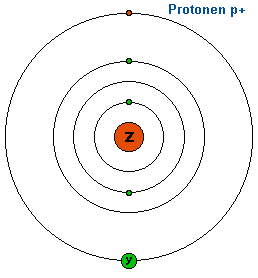
The hyperons always
start with the proton in their structure. At the top right, we
see the proton with all its components. However, to save space
in this presentation, we will use the smaller illustration in
the image below. It shows the proton's quark (Z) which has
charge +4/3, in the image in red color. Below the Z quark, in a
separate energy shell, we can see a y quark with charge -1/3,
colored green. In the same shell we also find an anti-neutrino,
colored red. The proton as a whole has a spin ratio of -1/2, so
we assume that when we later show the complicated shell
structures of the hyperons.
In classical physics, hyperons are said to be made up of
abstract combinations of certain base quarks. Here we shall
instead show a very concrete model which is based on the
addition of particles within a number of energy shells, outside
the proton:
Some basic rules:
There can only be two particles in the same shell, these
particles are always in line with each other. Particles in the
same shell must not have spins with "identical direction"
(unless they consist of opposite matter). Particles that are
adjacent to each other must also exhibit some form of attractive
force. |
 |
Electrical connection and spin-connection
There are, at this level, a few
different ways for particles to attract each other. What comes to mind first
is perhaps the electric force, acting between, for example, the proton and
the electron. Then there is a so-called "electroweak force", which in this
model is mediated by neutrinos. What kind of matter it is also reflects the
charge. By definition, positive matter is considered equal to positive charg
e, negative matter thus means negative charge. In order for a neutrino to be
able to pull together two particles of the same kind, it must therefore have
opposite matter and charge.
But the 'spin' of particles is also important in terms of attraction. Spin
is, according to this model, a kind of whirling motion of the entities of
the void. Individual particles inherit this motion from the motion of
light in vacuum. Particles can also
lack spin, neutrinos, however, always have spin. The rule is as follows:
Particles with the same matter and the same spin direction attract each
other. Particles that have opposite spins repel each other. Particles with
different matter/charge attract each other if the spin is opposite.
Antimatter is a localized absence of the entities of the void.
Introduction
The theoretical structure presented here does not necessarily correspond
exactly to reality. The model should instead be seen as a constructive
theory, which may later be revised. Mutual size and distance ratios between
particles do not match, of course. If true proportions were used, the
presentation would simply be unreadable. Before the reader embarks on the
hyperon structures, it may be useful to have a fundamental understanding of
the most common semistable particles, their creation and decay.
Read more here!
The Lambda hyperon
Λ
ͦ
|
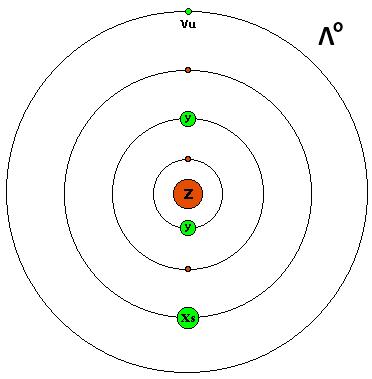
In the image to the right, the innermost shell thus constitutes
the proton's outer energy level with a y-quark and an
anti-neutrino. For example, lambda can be formed when a negative
pion π- reacts with a proton. On the right, we see how the pion
has divided its constituents into three different energy shells.
The y-quark in shell two binds electroweakly to the
anti-neutrino in shell one. An anti-neutrino in shell two also
couples electroweakly with the Xs quark in shell three. An
anti-neutrino in shell three holds the y-quark together with the
Vu neutrino at the far end of shell four.
Lambda usually
decays by emitting a pion π-. What probably happens is that the
perfect line of particles oscillates and breaks down. The Xs
quark and the neutrino at the bottom are then shifted along the
energy scale up to the y-quark and the neutrinos at the top.
Another product is the Xs and y-quarks fusing into an electron.
From the fusion energy, a y-anti-y pair is created which is sent
off as a neutral pion. |
 |
The Sigma-hyperon
Σ+
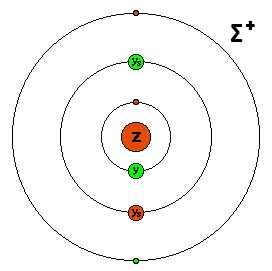
Sigma Σ+ can be
formed in the reaction Kˉ+p → Σ+ (+) π-. What probably happens
is that the kaon Kˉ merges into a pion π- which is immediately
emitted. From the fusion energy, a neutral pion is created where
the y-quarks with spin place themselves in shell two. In the
third shell, the pion's neutrino and anti-neutrino end up. One
could see Sigma Σ+ as a heavy proton with preserved charge +1
and spin value 1/2.
Sigma Σ+ usually decays into a proton and a neutral pion
π ͦ. The second scenario is that the ys and anti-ys quarks are
pulled together and annihilate each other. From the energy
arises a pion pair, π- and π+. But the negative pion never fully
develops into a pion but remains as an electron. The end result
is a neutron that emits a positive pion. At this stage, the
decomposition products start to become complicated. |
 |
The Sigma-hyperon
Σˉ
|
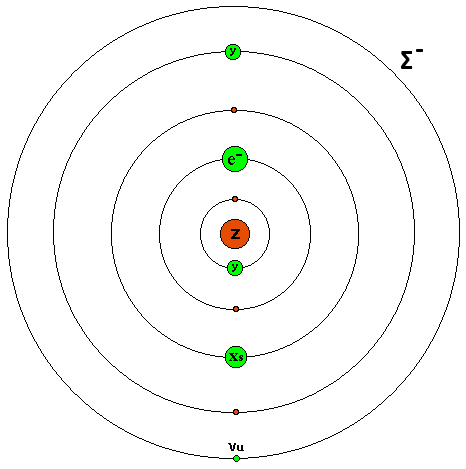
It is not known
which reaction creates Sigma Σˉbut it is probably the process
Kˉ+p → Σˉ (+) π+. The incoming Kˉ meson fuses into an electron.
From the fusion energy, a pion pair arises, π- and π+. The
negative pion remains in the system while the positive pion is
emitted. We see that the electron occupies position in shell no.
two. The negative pion spreads out a little more in the system.
Sigma Σˉ has only
one possibility to decay and that is by emitting a negative pion
π-. What remains then are the innermost two shells. In shell two
we see the electron with its anti-neutrino. This is in fact the
structure of the neutron and the decay is thus written as:
Σˉ→ n ͦ + π-. The neutron is relatively stable and decays only
after approx. 10 minutes in free state. |
 |
The Sigma-hyperon
Σ
ͦ
|
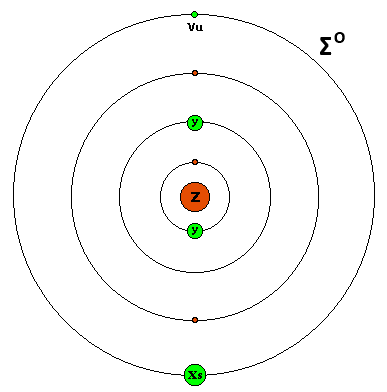
Sigma Σ ͦ is formed
from Sigma Σˉwhen it has lost its electron to a proton through a
so-called charge exchange reaction. If you look closely you see
that shell two only has one y-quark present, the rest is empty.
This is only temporary because the vacant position is filled
almost immediately. This happens by the anti-neutrino and the Xs
quark, at the bottom of the image, jumping into shells two and
three.
In doing so, Sigma Σ ͦ has
decayed in the only way it can, namely by emitting a photon, a
particle of light. The energy of the photons corresponds to the
energy difference between shell two and shell three/four. The
energy of the antineutrino is negligible, the energy mainly
comes from the Xs quark and its jump down to shell three. The
presence of a single photon as a decay product is a good
indication that the shell model for the hyperons is correct. The
reaction is written: Σ ͦ → Λ ͦ + ɣ |
 |
The Ksi-hyperon
Ξ
ͦ
|
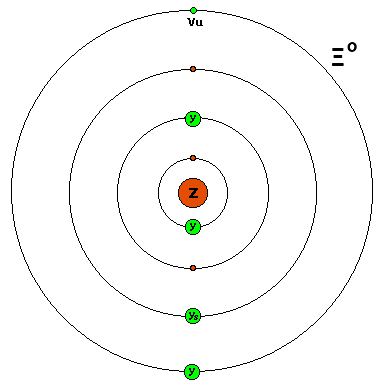
The neutral ksi
hyperon Ξ ͦ can be formed in the reaction: Kˉ+ p → Ξ ͦ + K ͦ.
The components of the negative kaon have simply taken place on
different shell levels. The y-quark in shell three is
dangerously close to the y-quark in shell four. As they are of
the same charge, they normally repel each other, but the spin
connection that occurs between Ys and the spin-free y causes
them to attract each other. The neutral K-meson emitted was
created by the collision, no particle reaction took place.
The decay of Ξ ͦ occurs by the
y-quark in the fourth shell jumping to the third. A merger then
takes place of ys and y, which results in an Xs quark. From the
fusion energy, a neutral pion is created which is immediately
emitted. The product of the decay becomes a Lambda Λ ͦ and a
pion π ͦ . No alternative decay of the ksi hyperon Ξ ͦ is
known. We can see here how incredibly strong the spin connection
can be. |
 |
The
Ksi-hyperon
Ξˉ
|
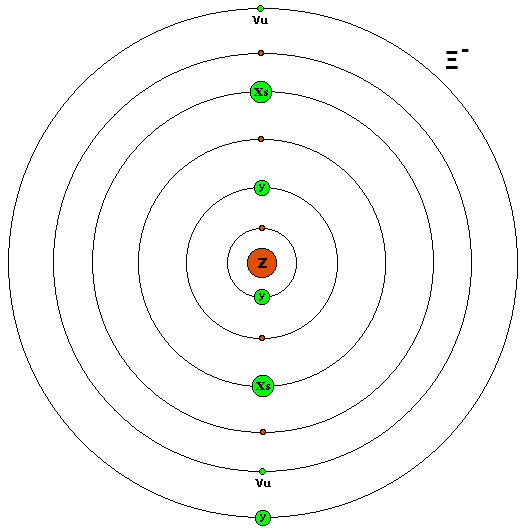
Ksi Ξˉ is formed in the reaction Kˉ+ p → Ξˉ + K+. What probably
happens is that Kˉ combines into a pion π- by the collision
itself. From the energy created by the fusion, a pion pair, π-
and π+, arises. One pion is dispatched while the other two take
their place in scales two through six. The Ξˉ hyperon is huge,
yet is not that much heavier than simpler hyperons.
The decay probably begins with
the particles' strict alignment coming out of balance. The
particles of one end are displaced towards the other end along
the shell lines. As a consequence, the Xs quarks will repel each
other and a pion π- is emitted. The particles that remain
redistribute into a Lambda. The reaction is written: Ξˉ → Λ ͦ +
π-. The scientists have spoken of "superstrings", is this what
they mean? |
 |
The
Omega Hyperon
Omega Ωˉ can be formed in the reaction Kˉ+ p → Ωˉ + K+ K ͦ . The Omega
Hyperon has a total of seven shells in its structure. Simply put, you can
say that Omega houses a negative kaon and a negative pion distributed in the
different shells. Omega is by no means the last of the hyperons but the last
we will describe in detail. Theoretically, you can construct particle lines
(strings) that are almost as long as you want, created from increasingly
violent energies, but somewhere you have to draw the line.
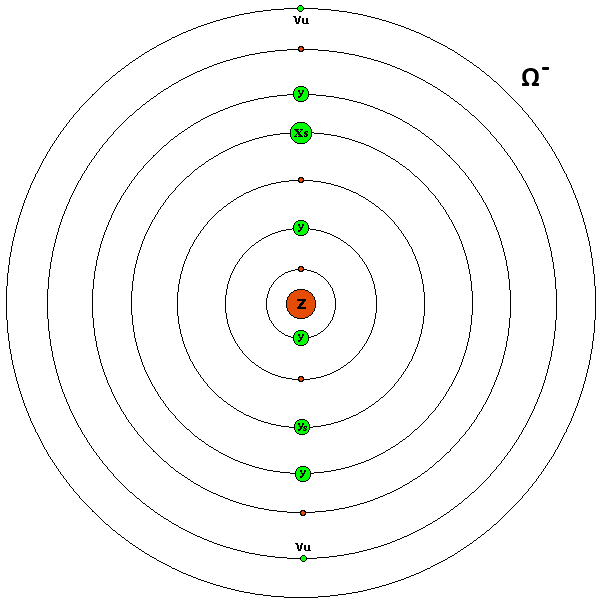
The
most common decay of the omega hyperon is (probably) that the particle
string breaks down, whereby a negative pion π- is broken off and a neutral
Ksi hyperon Ξ ͦ remains. The other natural way of decay should reasonably be
that a negative K-meson is emitted, whereby a negative pion remains and
forms a Lambda Λ ͦ , it seems to have been observed.
Several alternative decays are certainly possible, but here it becomes
difficult to even speculate. It is said that Omega can exist with other spin
or charge variants and that is probably conceivable. The question is whether
it pays to analyze further than this, it is unlikely to lead to any
immediate benefit. Of course, you can't be completely sure!
The old and the new
physics
To say I'm frustrated with the situation is putting it mildly. I consider
myself to have a very good and credible model of the void (vacuum), the
nature of light, particle formation and a theoretical structure for stable
and semi-stable particles. But what can be said about the physics of today?
It has completely different and not so logically defensible starting points.
First, the void is not considered to have any structure, nor is it
considered that antimatter is anything other than structural variants of
ordinary matter. In all seriousness, it is believed that the matter that
actually exists is only a small remnant from the 'Big Bang', after matter
and antimatter annihilated each other. They build their theoretical physics
on this vague foundation.
The whole of established physics and particle physics is described today
with abstract mathematical concepts and formulas. These theories are not
available to me, and I honestly don't even want to know what they present.
We don't speak the same language. I want to be able to create a clear and
distinct picture of what I want to convey. If something cannot be
visualized, I claim, with some justification, that it probably does not
exist either. Science has become hopelessly stuck in terms of a unified
theory of space, time and matter. I mean I am stuck with a simple and
comprehensible solution but have fundamental difficulties in reaching out.
This is the situation today and no breakthrough is at hand, this lockdown is
extremely regrettable and sad.
Disclaimer:
The information in this article is that of the
author and should not be confused with
conventional scientific views.
◄
Go back
|