|
Particle Physics
The
creation
of the electron
|
There are theoretical and mathematical models for the decay of the
semi-stable particles, but none that fully explain what actually takes place
down there in the microworld. I think that a more holistic approach is
needed and that is what I will try to present in this article.
Wobbling electrons
Why are semi-stable (non-permanent) particles formed at all? The answer lies
in the dynamical structure of the ordinary electron. The electron (and the
antiparticle the positron) consists of local deficits and surpluses
respectively in the void (vacuum). The void also consists of units and
thereby a particle such as the electron gets a certain elasticity. In other
words, the particle is malleable and not at all rigid in its structure, an
important detail in the context.
The electron is created together with its antiparticle from an energetic
light particle (photon). Photons always split at a specific energy level
where the wave function no longer hold together. But if the energy is higher
than that, or if there are collisions between particles, the electron itself
can start to oscillate, it starts to wobble. The electron is pulled out in
the direction of motion so that it resembles a rugby ball, then the electron
takes a drop shape in the direction of motion.
|
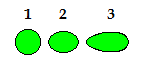
In the picture on
the right, we see three different oscillation stages of the
electron. If the available energy is high enough, the electron
can break apart and split up. This is in fact the starting point
that more particles than the electron itself can exist at all.
We'll follow this in more detail. |
 |
The division into quarks
|
Accelerating particles
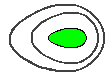
develop a G-wave field (standing gravity
waves) which is symbolically shown in the image to the right.
The extracted electron actually becomes somewhat drop-shaped.
This means that the division of the electron at lower energies
takes place as particles of different sizes; the shape of the
electron is asymmetric and the fission products will also be
accordingly. |
 |
|
Here, the wobbling
electron has just split into two quarks. With it, right from the
moment the electron was created, there are two anti-neutrinos,
'Ve'. They take position in different energy shells, they cannot
exist at the same energy levels.
|
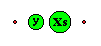 |
The small s-symbol of the X-quark denotes that the quark has 'spin'. The
phenomenon of spin is a kind of vortex motion that sometimes occurs in
elementary particles. What swirls are free entities from the void that I
call Nolites. As we can see from the image, the y-quark has no spin,
however, this fact contributes to the quarks being able to stick together.
But normally two particles with the same charge (which both quarks have)
must immediately repel each other.
However, the spin connection alone is not enough to link the quarks
together, a unifying neutrino is also needed which has the opposite
matter in relation to the quarks. The electron itself has two
surrounding electron neutrinos (Ve), but there is also another kind of
neutrino; Mu-neutrino (Vu). The latter is created in the process when
electrons themselves split up into quarks.
The genesis of the Mu-neutrino
|
The wobbling
electron here splits into two quarks. But a new particle also
arises from the fission energy. This particle is a neutrino of a
different kind; a Mu-neutrino. The Mu-neutrino has a weak charge
but inherits the spin from the Xs-quark, its 'mother'.
|
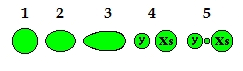 |
An Xs-quark, a y-quark, two electron neutrinos and a Mu-neutrino form a
semistable system that forms a charged Pi-meson. Since neutrinos always have
spin, we can now add up the total spin of the pi-meson, which gives the sum
0. The spins of the semistable particles are counted in half numbers,
opposite spins cancel each other out. The particles line up, charge
equilibrium occurs.
The charged Pi-meson
|
Now we see the final
product of the splitting of the electron. Since the Xs- quark
has 2/3 the mass of the electron, it consequently has 2/3 the
charge of the electron. The smaller y-quark has 1/3 the mass and
charge. The two neutrinos that followed from the time of the
electron have been considered by science to have no charge, but
they nevertheless have a weak charge that is of crucial
importance. These neutrinos are in fact the mediators of the
"electroweak force", which holds the two quarks together. The
slightly larger Vu-neutrino has the same kind of charge as the
quarks but its potential is considerably smaller (the
proportions of the image are of course arbitrary). |
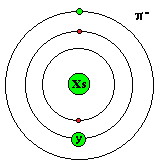 |
A special detail is that the particles within the semi-stable particles are
always in a straight line. They rotate around a point that we can call the
common charge point. An important factor is the existence of a number of
energy levels; shells. The inner particles of the pi-meson are distributed
in three different shells around the heavy Xs-quark. There can only be one
particle with spin in one and the same shell at a given time. However, we
see that the y-quark likes to share a shell with a Ve-neutrino, the y-quark
lacks spin and also has the opposite matter to the Ve-neutrino.
The creation of the Muon
|
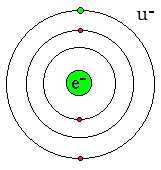
Muons usually arise
when charged pions decay according to the reaction Pi → u + Vu.
What happens during the decay of the pion (which is actually a
fusion) is that the Xs-quark and the y-quark are drawn closer
together under the influence of the intermediate neutrino.
Despite the electrical repulsion between the quarks, the weak
force overcomes the struggle and there is a fusion of Xs and y
into an electron. The fusion also produces two electron
neutrinos, Ve and anti-Ve. The neutrino which is of opposite
matter compared to the electron remains while the other one
leaves the system. The image on the right therefore shows a
"heavy electron", i.e. a Muon. |
 |
The composite electron
Even the Muon decays after a short time. What is likely to happen is that an
attractive weak force arises between the electron and the Vu-neutrino, which
after all consist of the same matter. The particle that conveys the force
is, of course, the Ve-neutrino, which is between these. In this process, the
Ve- neutrino falls into the first shell, whereby the Muon as a whole becomes
unstable (two particles with spin cannot be in the same shell). The Ve
neutrino returns to shell two while the Vu neutrino and the outer Ve
neutrino are sent away. Hence the reaction u → e + anti-Ve + Vu.
|
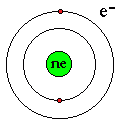
We distinguish
between the complete electron and the naked electron (ne). The
complete electron is composite but still stable. In the image on
the right, we see the naked electron in the middle surrounded by
two neutrinos of opposite matter, each in its own shell. The
electron is always surrounded by its two neutrinos. If one of
these should be knocked out or annihilated, a Ve-antiVe pair is
immediately formed out of vacuum. The neutrino which is of
opposite matter to the electron is retained by the system, the
other is emitted; the electron therefore never decays, it is to
be considered extremely stable. |
 |
The charged K-meson
|
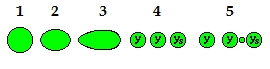
Back to the wobbling electron: If
the energy is high enough, the electron can instead be
fragmented into three y-quarks. As in the example above, the
y-quark has mass and charge 1/3. The quark in the direction of
motion is assigned the spin, the others have no spin. As before,
two Ve-neutrinos are also included. |
 |
|
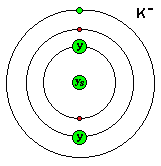
The fission
energy also gives rise to the Mu-neutrino Vu, created from the
ys-quark. We have thus collected the necessary particles within
the new system that form the semi-stable and charged K-meson. In
the picture we see that the y-quark with spin places itself in
the middle. In the first shell we find a y-quark together with a
Ve-neutrino, the same constellation as in shell no. 2. The third
shell contains only one Vu-neutrino and as we have seen before,
all internal particles always line up in a straight line. We can
also calculate from the inner particles that the spin of the K-meson is 0, because the Vu-neutrino has spin 1/2.
|
 |
The K-meson can decay in several different ways depending on which y-quarks
fuse first and which neutrinos participate in the reaction. In general, one
can say that a fusion of particles where the total spin number is even,
produces a two-particle decay. If, on the other hand, the spin number is
uneven, a three-particle decay occurs. I won't go into detail about the
process, which from this point on becomes increasingly complex and
unpredictable.
The neutral K-meson
|
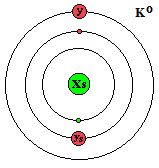
One of many decay
products when heavier nuclear particles interact is the neutral
K-meson. I present it mostly out of curiosity because it has
certain distinctive characteristics. We see an Xs-quark in the
middle with the charge minus 2/3. It is surrounded by two
y-quarks of opposite matter and charge. One of the y-quark's has
spin and is therefore designated "ys". Two electron neutrinos,
Ve and anti-Ve, also occupy respective shells. The ve-neutrino
has opposite spin to the ys-quark and places itself close. The
anti-Ve neutrino is indeed of the same matter as the y-quark,
but because the y-quark has no spin, the two particles can
tolerate each other through a so-called 'spin connection.' |
 |
The Xs-quark of the neutral
K-meson can relate to the ys-quark in two different ways. All particles in
the system are constantly in a straight line, but the Xs-quark also has an
'self-rotation' (either clockwise or anti clockwise). If the "spin field" of
the Xs-quark is in opposition to the ys-quark, then they are pulled towards
each other faster. But if the Xs-quark rotates in the other direction, the
frictional force of the spin field becomes smaller. The consequence is that
they are drawn towards each other much more slowly. In particle physics, we
speak of two different types of neutral K-mesons; KS and KL, where S stands
for "short" and L for "long". The decay of the neutral K-meson is crazy
complicated because the parameters are so many. Depending on which particles
within the system meet first, a certain decay occurs. If the spin-sum of the
decay is even, two new particles are formed, but if the sum is uneven, three
new particles are formed.
The diversity of combinations
The possibility of combining different kinds of quarks and neutrinos creates
the variety of semi-stable particles that the researchers have also measured
in their detectors. With this model as a basis, we can finally understand in
depth which processes really take place. We have yet only skimmed the
surface of the semi-stable particles' many secrets. If you add to that the
system of quarks in different shells, I am convinced that understanding is
further facilitated.
Let me mention that I have a complete model that explains in detail how
semi-stable nuclear particles (hyperons) are constructed and work. But
again, this is a peculiar knowledge, which at worst could serve as the most
effective sleeping pill imaginable (boring knowledge). But it may happen
that there is some specialist guru out there somewhere who thinks this is
important, then of course it may be worth the effort to delve into
this special subject.
Disclaimer:
The information in this article is that of the
author and should not be confused with
conventional scientific views.
◄
Go back
|