|
Particle Physics
Page 1
Page 2
|
It's a breathtaking journey to go far down into the smallest of the smallest
and visit one of our most common particles, the electron. In order to get
close to the electron, we have to let go of the scientific criteria that
determine what such a particle is and how it should be perceived. We do not
turn our backs on science, instead we add the concepts of intuition and
mysticism. We are viewing the electron from its own perspective, to grasp
its nature.
The structure of the void
To begin with, we must free ourselves from the idle image of elementary
particles as bounded objects in an absolute void. The void itself has a
structure, a geometry, even though we first cleaned out matter, light and
gravity. What remains is a dynamic vacuum in which matter and wave
formations can emerge. I choose to call the tangible units that define the
void 'Nol', the formless surroundings of the units I call 'Nil'. A Nol is
truly "atomos", indivisible, and thus constitutes a lower limit of the
cosmos. The units of vacuum are a defined limit to how small something can
be.
|
The image on the
right shows the units of the void in two dimensions. In three
dimensions, the pattern is similar to what is called "cubic
close packing" but without tight packing, because the Nol units
are quite sparse in relation to each other. The ideal distance
can be defined thus; "the seventh step is the return." In other
words, you can say that five tightly packed Nol (in theory) can
be pushed between two existing Nol. |
 |
The ideal distance is an
important principle because in its extension it shows the infinite extent of
the universe and is a basis in the understanding of electric fields.
The seven spatial fields
Even here I have to throw in a 'saving clause' about the void because there
are no less than seven different voids (space fields). But I will continue
to talk only about the simplest of them. Briefly, I can mention that the
next space field consists of combinations of Nol in patterns that create
larger but more transparent Nol. Higher spatial fields are combinations of
transparent Nol and so on (the seventh spatial field exists in a
spiritualized form beyond this world). Each spatial field consists of its
own Nol category and the ideal distances are the same for each spatial
field. Which space field you live in is important when it comes to "matter's
degree of transparency". You just mustn't confuse Nol with matter because
Nol are not particles, they are the units of the void. Matter appears, as we
shall show, when Nol in a spatial field regroup.
Furthermore, what has to be ephasised here is that Nol (of any kind) are not
'dense', they don't occupy space and have no 'image'. They do not interfere
with each other, still, they certainly RELATE to each other, it's sort of a
mystery. Nol are formless and shapeless 'ideas', like TAO.
The dual nature of light
Light can be described as a wave movement in a vacuum while at the same time
being a particle.
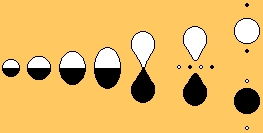
The illustration above can be read as a sequence in time, for example from
left to right. The light particle, the "photon", has here been frozen in its
movement at regular intervals. The negative (white) pole consists of vacuum
where Nol is in deficit compared to the ideal void. The positive (black)
pole consists of vacuum where Nol is in excess compared to the ideal void.
The poles are not stationary, they are attracted to each other and decrease
and increase respectively in size so that an oscillation (light wave) is
formed. The white and black poles show the electric moments of the photon.
In relation to the surroundings, they cancel each other out and the photon
is therefore electrically neutral. We will describe the nature of electric
fields in detail further on.
The reason why the poles do not engulf each other and disappear lies in
another aspect of the nature of photons called "spin". The individual photon
has a kind of rotation, and what rotates within the circumference of the
photon are the Nol units. Spin can be likened to a vortex motion where Nol
at the center of a particle moves rapidly in circular orbits. Out towards
the periphery, the speed decreases proportionally but by definition never
becomes exactly equal to zero. One can therefore speak of the photon as
having a "spin field". This field oscillates in a plane that is at a 90
degree angle to the electric field. When the electric field is at its
minimum, the spin field, or as you normally say "the magnetic field", is at
its strongest. An "electromagnetic wave motion".
The critical
point of the light wave
|
The photon have a critical point, a threshold energy (1.02 MeV)
where the wave function itself can no longer hold together. A
division of the photon's poles takes place and we have obtained
the particle e- and the antiparticle e+. These particles have
opposite mass and opposite charge. According to my own
definition, the electron (e-) has negative mass and negative
charge, the other particle (the positron) has positive mass and
positive charge (but it might be the other way around). |
 |
We may never determine through scientific experiments whether the electron
is a "hole" or an "excess" in a vacuum. The electron and its antiparticle
behave exactly the same in the reaction with light and gravity. The
important thing is that we can agree on a common definition. I suggest for
simplicity that negative mass is equated with negative charge. The concept
of "negative matter" may possibly create perplexity in some minds because
established science only recognizes that positive matter exists. For
example, it is claimed that the matter that exists is a remnant after "The
Big Bang" when matter and antimatter annihilated each other. I'm not mincing
words here: This is a silly myth that should be thrown into the trash as
soon as possible!
The mysterious neutrino
|
At the same
moment the electron and the positron finally split from each
other, two new particle pairs arise from the dividing energy.
Each of the two particle pairs consists of a neutrino Ve and the
antineutrino anti-Ve. The reason these particle pairs are formed
is that the total energy strives for an even distribution in
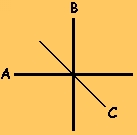
three planes. In the image to the right, plane A can stand for
"forward/backward" while B stands for "right/left". Planet C,
finally, stands for the "up/down" dimension. When all three of
these planes are represented by a pair of particles, the
distribution is symmetric. In the example, the plane B can
represent the particles e- and e+. |
 |
The neutrino and its antiparticle are like tiny copies of the positron and
the electron. In scientific circles, there has been disagreement on the
question of whether neutrinos have mass or not. But in my view, they not
only have mass but also a weak electric charge. It is in fact neutrinos and
antineutrinos that account for the so-called 'electroweak force', a property
that allows quarks within heavier particles to stick together. When the
photon split, the electron/positron pair each took over part of the photon's
spin. For example, the spin of the electron is usually defined as ½. The
same applies to the two particle pairs Ve and anti-Ve, they are similarly
considered to have spin ½. Particles with unified spin do not want to
coincide at the same energy level, but I will try to show how the electron
solves this by keeping its neutrinos in different "energy shells".
The 'naked
electron'
|
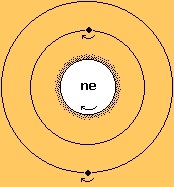
Here in the image on the right we see the naked electron,
denoted 'ne', surrounded by its two neutrinos in different
orbits or energy shells. The neutrinos describe a kind of bound
rotation, because the three particles always lie in line with
each other due to the electrical repulsion between the
neutrinos. The positive weak charge of neutrinos, on the other
hand, attracts the negative electron. The opposite spin ratio
between the electron and the neutrinos means that the latter are
not drawn into the electron (unified spin in the case of
particles of different matter). The rules for energy shells
state that only one particle with spin can be in a shell at a
time. Two particles with unified spin in the same shell lead to
the decay of the parent particle. |
 |
We have only examined the electron here. The antiparticle (the positron)
works the same way, but is of course positively charged and surrounded by
two antineutrinos. A bare electron or positron never exists in the free
state. If a neutrino is knocked out, a new pair (Ve and anti-Ve) immediately
creates out of vacuum, the unwanted neutrino is emitted and the other is
retained. In a thin layer near the surface of the naked electron, a cloud of
small particles is seen. They are called 'nolites' and are units from the
nol of the void that have broken away and now exist as free particles.
The opposite, individual "Nol
holes" in vacuum are called 'Nilites'. Both exist in abundant quantities in
the infinite cosmos, but they also constantly annihilate each other by
Nolites occasionally "tumbling down" Nil holes. Nolites and Nilites are the
smallest units that can properly be called particles. We should remind again
that the Nol and Nil of the void are not particles because they are part of
the vacuum fabric. Nolites seek out the absolute outer rim of the electron,
Nilites seek out the positron in the same way. However, it is not a question
of any quantum order, the number of Nolites around an electron is constantly
changing.
Disclaimer:
The information in this article is that of the
author and should not be confused with
conventional scientific views.
►
To part two
The
content of astromantra.se is exclusively my own material if nothing else
stated.
Publications and other content may be copied for yourself or other parties.
Selling content to third parties is not allowed. The author. JRSN
|