|
Particle Physics
Page 1
Page 2
|
In the previous section we covered the fundamental properties of the void.
We showed how the electron and its antiparticle the were created when the
light particle, the photon, had reached a critical value and split into two
electrically charged particles. It was also shown that neutrinos are
included as an obvious part of the electron's nature and that these have
mass as well as a weak charge. This page is a further study and deep dive
into other electron associated aspects.
Electric fields
|
The image on the
right shows how a shift among the Nol of the void has occurred
(read part 1 about Nol). An area of Nolites has thereby been
formed in the left of the image and an area of Nilites has
been formed on the right. No electric fields are yet visible,
but they arise as soon as the displacement has taken place. The
void is dynamic and immediately adapts to the new situation. In
the case of the area of Nolites, the Nol in the immediate
surroundings will try to escape outwards to regain as much as
possible the ideal state of the void.
|
 |
In the case of the area with
Nilites, the surrounding Nol will instead be drawn in towards the center in
order to regain the ideal distance between all the Nol in the void. In
neither case will the equalization succeed completely and the result will be
a "disturbance" in the ideal vacuum field. The area where Nol is denser than
normal has created a positive electric field and the area where Nol is in
deficit has created a negative electric field. The fields will not cease to
exist until the opposing areas meet and neutralize each other. The electron
and the antiparticle the positron have a corresponding effect on the void.
According to the definition in part 1, it is the electron that forms a
"hole" in vacuum with negative mass and as a consequence; negative charge.
Vacuum geometry
Why then does the electron have the mass it does? It is inherently true that
the electron and positron were created at a certain energy, when the photon
reached its critical point (see Part 1). But this alone cannot explain why
the electron retains its mass and remains a stable particle. Theoretically,
free Nolites and Nilites should over time "shrink" electrons and positrons
and cause them to fade out, but this does not seem to happen in nature. The
explanation lies in the spherical shape of the naked electron. The
electron's free Nolites have the exact number corresponding to a perfect
geometric shape in three dimensions. If Nolites are added to or removed from
this number, the electron will immediately regain the perfect shape by
regulating the difference against the void.
This ability of the vacuum to reward symmetrical shapes is what I call
Vacuum geometry. It is this phenomenon that causes elementary particles to
appear at very specific energy levels. I intend to show in later
dissertations how the electron in turn divides into quarks. Even these
quarks must then each correspond to a perfect geometric shape. In the case
of the photon, a stable form is not possible because its mass continuously
changes from a minimum to a maximum and back again. One must assume that the
photon still retains its energy in the encounter with free Nolites and
Nilites. Probably a Nol/Nil pair formation takes place, one particle
"repairs" the resulting damage while the other is ejected.
The electron as a wave
An electron moving in vacuum does not always consist of the same Nilites.
The movement itself occurs when the electron "picks up" Nil from the vacuum
in the direction of travel and emits the same number of Nil in the "exit
direction", i.e. backwards. If we instead study the vacuum Nol when the
electron passes by, we will find that they move in the opposite direction
compared to the electron's direction of travel. The positron consequently
acquires opposite properties, it borrows Nol in the direction of travel and
emits the same number of Nol backwards. The electron and the positron move
in vacuum without energy loss, i.e. vacuum lacks "syrup characteristics".
The inherent "inertia" of matter has nothing to do with the movement itself,
but is an effect of standing gravitational waves around particles (more on
this later).
The magnetic condition of the electron
|
Electrons and positrons in motion behave as if they were small
magnets. The phenomenon is an effect of the 'spin' of the
particles and the Nol/Nil units of the void. The picture shows a
positron moving from left to right. Point A shows a Nol in
vacuum which is dragged in a curve along to point B. |
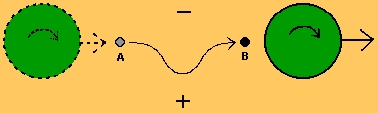 |
In Part 1 we touched on the nature of the spin and noted that it was
strongest in the center of the particle and decreased in strength outwards.
What happens in our example is that the Nol of the vacuum, due to the
direction of the spin, will be shifted a bit forward while being pushed down
in a u-curve. This compression of Nol downwards, forms what is the
positron's magnetic plus pole, the corresponding thinning of the space's Nol
forms the positron's magnetic minus pole. We can immediately state here that
if an electron or a positron is at rest in relation to the vacuum, no
magnetic moment arises, a continuous forward motion is required.
Gravitation on the particle level
|
Light is usually described as a transverse wave movement.
However, the corresponding longitudinal wave motion is just as
common, it flows through the cosmos in all directions. The waves
are similar to sound waves, but instead of air as a medium, the
longitudinal waves (G-waves) move in the vacuum. The fact that
science has not been able to register these waves is because the
speed is many times faster than the speed of light! The G-waves
actually emanate from the center of all beings. Here, physics is
rapidly approaching the spiritual realm. G-waves occur within
seven frequency ranges, in reality corresponding to certain
levels of existence. |
 |
Counting from the bottom, these levels are; the particle level, the cell
level, the human level, the planet/sun level, the galaxy level, the galaxy
cluster level and the hyperspace level (the latter being a thoroughly
spiritualized existence). The frequency range we usually associate with
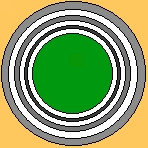
gravity is found at the level known as the planet/sun level. At the particle
level, so-called standing waves occur around a particle (see image above
right). This phenomenon is usually called interference, waves from outside
and waves that are reflected back form an interference pattern.
The 'excited' state of the electron
|
Elementary school physics teaches us that electrons supplied
with energy, jump to more energetic orbits (in the atom). When
they then jump back, the excess energy is emitted in the form of
a light quantum, a photon. Where was the energy then when the
electron was in its energy-rich (excited) state? We can
understand this if a model is introduced where a single photon
can attach to a charged particle and form so-called 'bound
light'. |
 |
Consider the image above on the right. We see there a single photon whose
wave pattern lies in an elliptical orbit around an electron, marked as a
white dot. The photon's positive pole must constantly face the negative
electron in order for the photon to remain in its orbit. But the point is
that the photon's electric and magnetic fields change direction at half the
wavelength. If the photon wants to remain in orbit, it needs to "flip over"
and rotate 180 degrees. This occurs at the turning point 'tp', when it is
furthest from the electron. All matter has a constant quantity of bound
light, which can be described as the light body of matter.
An electron moving around an atomic nucleus describes an elliptical path.
When the electron is closest to the heavier nucleus, a shift occurs whereby
the direction of movement changes slightly. In this way, the electron will
move in "rosette orbits" around the nucleus. An ordinary electron moves
quickly and in tight orbits around the nucleus, but if a photon binds to the
electron, it suddenly becomes heavier and loses some of its speed. The
electron cannot maintain its previous trajectory with preserved stability,
but enters a larger ellipse that is further from the nucleus. When
the photon is eventually emitted, the electron regains its original
trajectory.
Disclaimer:
The information in this article is that of the
author and should not be confused with
conventional scientific views.
◄
To the menu: Particle Physics
The
content of astromantra.se is exclusively my own material if nothing else
stated.
Publications and other content may be copied for yourself or other parties.
Selling content to third parties is not allowed. The author. JRSN
|