|
Particle Physics
Elementary
particles
|
It's a mystery how the simplest particle of the atomic nucleus can be so
stable and yet react so actively with other particles. What does the
internal structure of the proton really look like and what happens during an
interaction with the proton's 'sibling', the neutron?
The structure of the proton
This proton model is based on
neutrinos having both mass, charge and an ability to be at rest
in the void. Therefore, the neutrino is actually seen as the
carrier of the weak force. A neutrino can hold together two
quarks of the same charge if it is itself of opposite polarity.
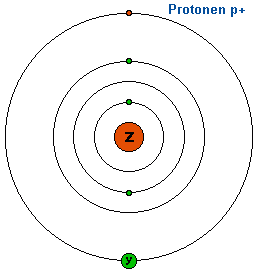
The image shows the internal structure of the proton. A positive
Z-quark in the center is flanked by three electron neutrinos and
a negative y-quark with an associated antineutrino in an outer
shell.
The proton system outwardly resembles a small solar system, but
that's where the similarity ends, because the six particles are
always aligned and rotate based on the charge center of the
Z-quark. There is no real connection to the concept of
superstrings but the idea is similar; the individual particles
are constantly in conjunction. The energy string rotates in all
directions with such enormous speed that the proton appears
homogeneous. The proton in itself is stable. |
 |
The basic particles
The quarks in this
model should not be confused with the quarks of mainstream
physics, the rules do not match. However, here too there are
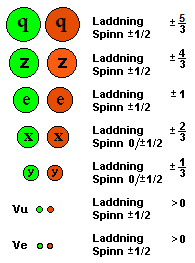
charges of 1/3 and 2/3. A heavier quark, called Z, has a charge
of 4/3. The Z-quark is likely created by splitting the even
heavier but short-lived Q-quark. This quark cannot exist in a
free state, but is created as a precursor to the proton and its
antiparticle. However, the Q-quark has spin ½ as it is a product
of energetic light waves. Further down the page, a theory is
given on how a proton pair can be created by the collision of
gamma waves.
Quarks with unified charges cannot normally merge due to the
electrical repulsion, but when two spins are aligned or a spin
is opposed to a spinless particle, a spin connection takes place
with an attraction effect. The spin is extremely important at
the particle level. |
 |
The spin ratio of the proton
The proton as a whole has spin ½ which leads us to analyze its individual
particles. We give the heavy Z-quark a positive spin (+ ½) by analogy with
its charge. Neutrinos always have spin ½ and we have in the nucleus three
"negative" neutrinos with spin (- ½) and one "positive" neutrino with spin
(+ ½). If we add this up, we end up with spin (– ½) and we can then conclude
that the proton's Y-quark has no spin at all.
The wobbling electron
|
Before we can
approach the creation of quarks, we must first study one of the
properties of the electron. In collisions or spontaneously at
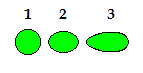
high energies, the electron may start to oscillate (wobble). The
electron is not static but has a plastic nature. This plasticity
allows the electron to split. |
 |
The light wave (photon) has a
threshold energy at 1.02 MeV where the photon splits and forms an
electron/positron pair. If the energy should be higher than the threshold
energy, the formed particles could begin to oscillate. It is this wobbling
that can give rise to the special phenomenon called; quark formation. Quarks
exist in a few base varieties but they also have 'spin properties'.
Quark creation
|
If the oscillating
electron splits at a certain energy level, an Xs- quark and a
Y-quark are created. The existing G-wave field around the
accelerating electron (a droplet-shaped structure) causes a
smaller quark (y) to form behind the larger Xs-quark. In
addition, a Vu-neutrino is formed from the mass of the X quark. |
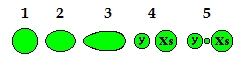 |
The spin during the splitting
remains in this reaction with the X-quark, hence its name, Xs. Two
(anti)-electron neutrinos also exist from the late electron time. They are
not shown in the picture but are there to hold the different quarks
together. Classical physics terms their impact role as; "electroweak
interaction". These neutrinos have little mass and weak charge.
|
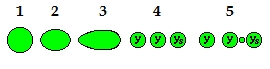
When the electron
splits at a higher energy level, the split takes place in the
form of three y-quarks, a so-called Kaon. The spin ends up in
the first of the quarks in the direction of motion. A
Vu-neutrino is also produced in the fission energy. |
 |
The Neutron
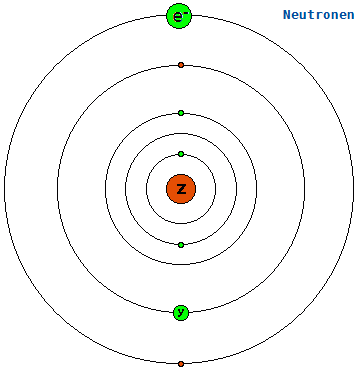
The proton has a
slightly heavier sibling particle that is electrically neutral;
The neutron. What separates the particles is a new shell that we
place on top of the others. An electron attaches to this shell
in line with the other particles but in a position as far from
the proton's y-quark as possible. It will thereby bind with the
electroweak force to the proton's antineutrino while at the same
time attracting the positive Z quark.
One of the electron's two associated antineutrinos settles in
the same shell, in line with the others. It takes its position
closest to the proton's y-quark, which it attracts
electromagnetically but also with some spin connection. The
remaining antineutrino has no place in the system but is sent
away. A neutron decaying creates a neutrino pair out of vacuum,
the electron keeps the antineutrino for completion and the
neutrino is sent away. |
 |
Strong interaction (the strong force)
In a heavier atom with multiple nuclear particles, electrons are not
attached to specific protons. There is a constant exchange of the particles
in the outer shell of the nucleons, which also includes the neutron's
outermost antineutrino. The exchange means that two protons, which should
repel each other, are instead bound together very strongly. However, this
strong interaction quickly loses its influence as soon as the distance
between the protons increases. But even in the absence of electrons there is
a strong interaction between protons, the force is then mediated by an
exchange of the protons' y- quarks.
At the atomic level, the neutron's electron is expected to be able to form a
stable compound with its antineutrino, which gives the negatively charged
exchange particle W, one of the so-called "bosons". In the free state, the
electron always wants to surround itself with two antineutrinos, the W-boson
is thus exclusively an alliance that is formed when the atomic number (the
number of protons in the atomic nucleus) is greater than 1. The neutron is
not completely stable in the free state, but decays with a half-life of
about 10 min. It is probably free neutrinos in vacuum that react with the
neutron's antineutrinos, the result is decay; n → p + anti-Ve.
The creation of a proton- anti-proton pair
|
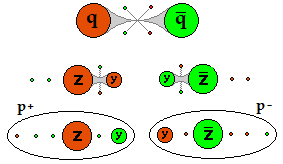
The proton and antiproton can
be "simply" created by colliding nuclear particles. Example: p+p
→ p+p+p+anti-p. But a more basic creation process is certainly
possible by colliding energetic gamma waves. On the right, we
see how two quarks (q), theoretically, are created in such a
reaction. In the pair formation itself, two Ve-neutrino pairs
are also created. However, the Q-quark quickly splits and
detaches off a y-quark. Here, too, a neutrino pair is created. A
quick redistribution takes place of the "quark soup" that has
formed. The end result is a proton and an anti-proton. No waste
particles are formed in the reaction. |
 |
Disclaimer:
The information in this article is that of the
author and should not be confused with
conventional scientific views.
◄
Go back
|