|
Cosmology
Galactic
division -
Equal parts matter
and anti-matter
|
Planet
formation in a rotating disc of dust around a newly formed sun, that's how
science believes the planets came into being. But does this match reality?
There are serious flaws in this model. Perhaps new planets arrive from an
area far beyond the solar center.
The classic model
|
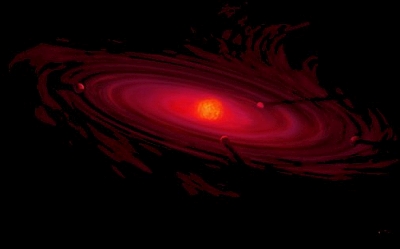
The established
theory of the formation of planets envisages that they are
created from the remnants of a rotating disc of gas with the Sun
as the central body. One problem here is that rotation doesn't
really reward accretion of material in local regions outside the
Sun. The logic that elements of greater density would end up in
the periphery instead of in the center of the sun does not feel
completely reliable. What could be a possibility, however, is
that two or more suns are formed simultaneously from the same
disk of gas. Two centers of mass distribution are probably the
most common model. |
 |
But if the
contracting gas cloud produces only suns, gas giants or dwarf stars, then
the mystery of how planets form still remains. There must be another process
responsible for the population of minor planets. In order to fully
understand that process, we first need to look a little more at the
mechanics of the sun; how the sun actually works. Here, the established
theory is likely correct. Hydrogen atoms under pressure fuse into deuterium
and then into helium.
However, it is not in the core of the sun that the reactions take place,
this too is a myth left over from classical astronomy. The high pressure and
density takes place in the photosphere and in the chromosphere. In this
area, energy is dissipated by the fusion of hydrogen into helium. The mass
reduction creates an excess of energy that radiates out and creates the
corona's classically high temperatures. The effect is enhanced by electrons
from the Universe meeting and reacting with the solar wind consisting of
positive protons and alpha particles.
The solar wind and the Oort
cloud
|
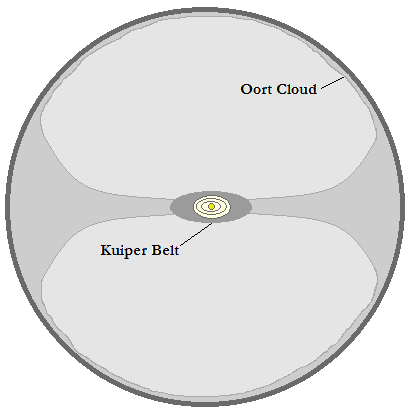
The outward solar
wind of mostly positive protons will create a balance point
against the inward gravity. This balance point is manifested as
a bubble at a great distance from the Sun, even outside the
so-called Kuiper belt. The boundary layer of the bubble is
usually called the "Oort cloud" and is characterized by an area
filled with dust, rocks, asteroids, comets and even planetary
bodies.
All of these objects are characterized by being at rest relative
to the sun and the solar system. They thus have no intrinsic
motion (rotation) like the planets of the solar system. In order
for an Oort cloud object to be able to break free and move into
the solar system, the object must receive a push from the
outside. Such an event can lead to a small or large object,
falling into the solar system and attaining its own orbit.
Sometimes the result is a comet, sometimes an entirely new
planet. |
 |
Growing planets
|
A planetary
substance that has just arrived from the Oort cloud is not a
complete planet, it must therefore be referred to as a
"protoplanet". The reason is that the object that has now ended
up in the vicinity of the sun is partly exposed to a higher
gravitational pressure, and partly to heating by the sun's rays.
The result is that the interior of the object begins to glow.
Gases arise that create a cavity in the interior.
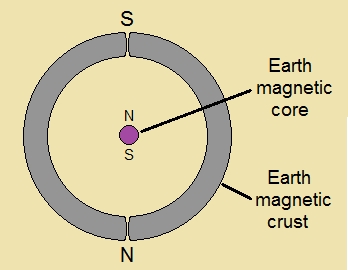
The gases are released in the object's north and south poles. In
the center of the object, a magnetic and luminous crystal-iron
core is formed. As the protoplanet swells and cracks, continents
form on the surface. The water that collects on the surface
creates seas and oceans but also flows in and forms an "inner
ocean", an ocean that is effectively "inside" the Earth's crust. |
 |
Hollow Earth
But if our
earth is hollow and contains an inner ocean, shouldn't we already know that?
The topic is a bit sensitive, for many reasons. There are pretty strong
indications that the inner Earth is already inhabited. The inhabitants are
more advanced than us and have superior technology. Some authorities on our
planet know this but have chosen not to announce the matter. As usual, you
don't want people to know more than absolutely necessary, it could threaten
the positions of power of the rulers. That planets are hollow and arrive
from outside is considered "dangerous knowledge", it overturns our
prevailing scientific paradigm. Therefore, our solar system is presented as
static, as an unchanging system.
Inner Earth is an independent sphere of life with a radiant 'sun' floating
weightlessly in the center of the planet. Here, too, there are seas and land
areas. It can be assumed that clouds also form from condensation and that
rain falls and irrigates the vegetation. Due to a higher carbon dioxide
content in the atmosphere; plants, animals and people grow large (here there
are no pseudo-debates whether carbon dioxide destroys the environment or
not). But the Inner Earth belongs to a different category in terms of living
areas and the inhabitants stick to the protocol; one is not allowed to move
freely between the inner and the outer earth. Only in exceptional cases have
individual people been given permission to change their place of residence.
Other consequences
The existing time frames regarding the age of the earth and the solar system
are, by all accounts, taken completely out of thin air, i.e. pure
"fabrications". There is talk of an age of our solar system of approx. 4.5
billion years (based on what then?) Science throws millions and billions of
years here and there, but when it comes to presenting credible concrete
theories about age calculation, the evidence is very scarce. The
alternative, however, is not biblical theories of evolution, which are
instead ridiculously young, in the order of 6000 years for the entire
creation. It is extremely difficult to determine a reasonable age of our
solar system. What we can ascertain though, is that groundbreaking events
are taking place all the time.
There is really no difference between established planets and incoming
larger comets. What is characterized as cometary features are a luminous
coma, a luminous tail, and sometimes a luminous "spike" in the direction of
motion. All of these are examples of plasma properties of space objects that
break electrical barriers in space. A stationary planet in a stable orbit
around the Sun is always in the same "charge zone". An incoming object, on
the other hand, has a very elongated orbital, thereby it will electrically
discharge itself against the solar wind. The result is a luminous coma and a
tail of electrically charged particles. Planet Venus was originally a comet!
Planets from gas giants
There are indeed alternatives to planet formation in a solar system. This is
when larger stars or gas giants "calve off" and give off mass that then
forms planets. The planet Venus is a good example. Mythology tells us that
Venus was born from the "head of Zeus", which sounds pretty absurd. But when
you consider that Zeus is the same as the gas planet Jupiter, it becomes
less illogical. A larger object (a star) is said to have passed close to
Jupiter. No collision has taken place but only from the attraction between
the objects a portion of Jupiter has been torn away. Oral tradition tells of
Venus moving around the solar system like a raging comet. At one point,
Venus came dangerously close to the planet Mars. The consequence was that
Mars received a long scar on the surface from a discharge of electrical
plasma. In addition, Venus dragged large parts of Mars' atmosphere and
oceans with it.
The planet Venus eventually established itself and acquired the stable orbit
it has today. Mars went from being a water planet to becoming a more desert
planet. Even the planet Mars may have been a product of Jupiter's mass. Our
solar system is not a single entity, it is binary. In orbit around the sun
moves a lesser-known star; Nibiru. It is usually obscured but has played a
major role in the production of new celestial bodies. Jupiter used to be a
full star, a brilliant yellow sun. But Nibiru, a small but massive star,
caused Jupiter to split in two; into a great yellow sun (our own) and the
now more modest Jupiter. It may sound unbelievable, but even Saturn is
believed to be a product of Nibiru's previous passage of our solar system:
Saturn, Venus, Mars and probably some moons. Early Jupiter (UR-BAR-RA) must
have been a giant sun.
Disclaimer:
The information in this
article is that of the
author and should not be confused with
conventional scientific views.
◄
Go back
|