|
Cosmology
|
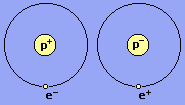
The universe contains two
types of hydrogen. Either a positive nucleus is surrounded by a negative
particle or a negative nucleus is surrounded by a positive particle. The
proton is created in pair with its antiparticle. We know ordinary hydrogen;
where is anti-hydrogen?
Atomic matter
In order for it to be completely clear which type of matter we talk about,
we need to introduce a definition of the matter in question. Here then,
matter is meant on the atomic plane; protons and neutrons, which are
surrounded by the lighter electrons. We also disregard the neutrons in our
consideration so that only the element hydrogen in its simplest form remains:
AM1 =
Atomic Matter Type 1: Positive Nuclear Particles (Protons)
surrounded by negative satellite particles (electrons).
AM2 = Atomic Matter Type 2: Negative Nuclear Particles
(Antiprotons)
surrounded by positive satellite particles (positrons). |
 |
A stable environment
In order for matter to accumulate and form larger objects such as planets,
suns and galaxies, the current contracting gas cloud must consist of the
same type of atomic matter. If AM1 and AM2 were to meet in the same area,
they annihilate each other. The residual product, in the meeting between
matter and antimatter, immediately forms new matter, but the atomic
structure is not regenerated, but the matter remains in its plasma state
(free protons and free electrons). Plasma clouds are always precursors when
atomic matter is formed.
The atomic matter must thus first divide into two separate areas where each
area consists only of a specific type of atomic matter. We have already been
able to conclude that our solar system consists of one and the same type of
atomic matter. Purely by definition, we consider the proton to have a
positive charge and electrons to have a negative charge. Observations alone
cannot determine what type of matter, for example, a sun is made of. Even
gravity reacts in the same way towards both types of matter.
Cosmic melting pot
Now if there are specific regions where plasma divides into atomic gas
clouds, shouldn't we be able to visually locate these regions? The answer
is: We can and we do, however, we are so used to the structures that we do
not immediately interpret them correctly. The division into AM1 and AM2 does
not take place at the solar level but at the galaxy level. So we have to go
back to Edwin Hubble's classification of the shape of galaxies.
The structures that are particularly interesting in this context are the bar
spiral galaxies and to some extent the galaxies called "Theta". What is
called for is a structure with a central hearth surrounded by two outer
densifications. It is also crucial whether the central plasma core initially
has a rotation or not. The most common seems to be that the core contracts
during rotation, the second option is one of the exceptions.
Galactic
division
|
Let's
begin by studying a rotating plasma core that has just created
atomic matter in two regions on either side of the core. In
Hubble's classification, this galaxy structure is called SBa
type galaxies. The central core is still pronounced and from
both matter regions each spiral arm emanates where stars are
formed by condensation of gas. |
 |
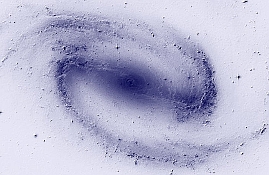
In the further development, the core part shrinks and the structure is now
called SBb (see the galaxy at the top of the page). The central plasma core
will eventually disappear completely.
|
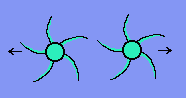
Assuming its original rotation was strong enough, now even the
two regions of different atomic matter will part from each
other. They have now evolved into two independent spiral
galaxies. They are sibling galaxies but the matter of one is
diametrically opposed to the matter of the other. As a rule,
both remain within the common galaxy cluster. |
 |
Non-rotating system's
|
When
the central plasma core lacks rotation, a different structure
occurs. There is a galactic nucleus as before, but the atomic
matter that forms settles into two spherical regions opposite
each other. The result is an SB0 type galaxy. Here, it is only
the outward force in the core's particle reactions that
counteracts the contracting force. |
 |
|
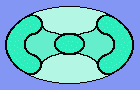
The
central plasma core continues to shrink while the regions of
matter on either side grow in size. This form is usually called
a Theta-type galaxy, after the Greek letter. Decisive for
whether the two areas of matter manage to separate from each
other is the mass of the plasma core, a larger mass creates the
necessary gas pressure before the division. |
 |
It is uncertain how the final galaxies will take shape after a breakup in a
non-rotating system. However, it is probably not about elliptical galaxies.
These are most likely the end stages of older spiral galaxies when rotation
has stopped and the spiral arms are no longer visible. As for non-rotating
plasma cores, one can instead assume that they form irregular galaxies
(galaxies without a specific shape).
Galactic interference
It is by no means the case that galaxies of different atomic matter explode
if they collide. Galaxies consist mostly of voids and it is still the
gravitational forces that govern these processes. The solar wind, which
mostly consists of protons, also creates a repulsion force around the stars
in a galaxy that counteracts collisions with other celestial bodies.
However, it cannot be ruled out that galaxies "adopt" parts of other
galaxies, even those with the opposite matter type. However, a new galaxy
always consists of the same matter; AM1 or AM2.
◄
Go back
|