|
Particle Physics
|
What happens in
reality when kinetic energy moves from one object to another? Is it at all
possible to understand the transformation of light into material movement
and vice versa? We've been talking about kinetic energy as a concept, now we
have to check the details.
Gravitational waves
Gravitation plays a crucial role in understanding the kinetic energy of
objects. But we don't have much help from the traditional model, a more
modern view of the dynamics of gravity is needed. According to the latter,
the universe is filled with gravitational waves (G-waves) coming from all
directions in space. Particles and even larger objects react to incoming
waves by forming kinetic energy fields in their surroundings. A particle
that is in uniform motion will stack longitudinal waves around itself, the
wavelength being slightly shorter in the direction of motion and more
extended in the "exit direction" (ie backwards). With this in mind, we can
begin to study the transformation of energy.
The
'billiards effect'
The
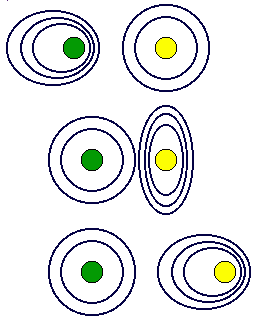
simplest energy conversion is when one object transfers its
kinetic energy to another object. In the image to the right, a
green particle moves from the left in the direction of a
stationary yellow particle. The green particle is seen with an
additional wave field symbolizing its kinetic energy. When the
particles collide (middle), the yellow particle takes over a
G-wave from the green particle. The yellow particle must now
move in the opposite direction based on the incoming wave.
We can easily state that this movement model is not entirely
compatible with Einstein's theories. After all, Einstein meant
that two objects that move in relation to each other (in some
strange way) can be both in motion and at rest at the same time.
According to this model, it is the wave field of the particle
that determines its motion. In other words, the void itself has
a "resting frequency" for G-waves, particles correspondingly
have a "resting wave field" when at rest. The particle "knows"
itself what speed it is in (for what chaos would it be
otherwise). |
 |
The
creation of light
When
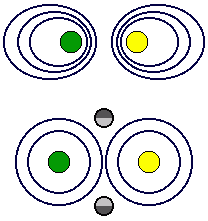
matter collides, light particles (photons) might be formed.
Exactly how it happens has been a riddle, but this model can
broadly describe the process. In the image on the right,
particle green collides with particle yellow. In the collision,
we see how both particles end up in a state of rest, but that
two dipoles are created from their previous kinetic energy
field. The term "dipoles" is used because these have not yet
developed into photons, what is still missing is the "spin".
A dipole formed in vacuum cannot favor a pole in the direction
of motion. It must therefore turn 90 degrees so that both the
minus and plus poles become equal. As the dipole twists, there
is a kind of "friction" against vacuum and a spin movement
occurs; a photon has been created. In a strong collision, more
wave fields can be converted into dipoles/photons, but the
effect is always quantified. |
 |
Light
to kinetic movement
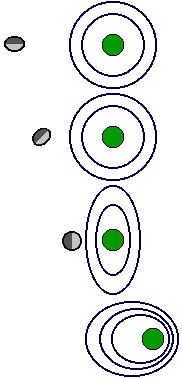
A photon can provide
kinetic energy to a particle (image on the right). A photon
entering from the left moves towards the green particle, which
is at rest. As the photon gets even closer, it begins to twist
so that its positive field is directed toward the negative
particle (which is usually an electron). When the 90 degree turn
is fully completed, the photon's spin has ceased and what
remains is thus called a "dipole".
In the next stage, the dipole is converted into an additional
wave field around the green particle (wave fields around
particles always consist of minus fields and plus fields in
combination, this is not evident from the simplified images).
When the particle is assigned a wave field more than what its
resting field represents, it is by definition in motion. You can
also read the sequence "from bottom to top"; this produces a
particle that is slowed down, forming a dipole. The particle is
brought to rest and the dipole twists to form a photon.
In the special process when an atom is excited by an energetic
light particle, no actual energy conversion takes place. The
photons then settle in a closed orbit around one of the atom's
electrons. The now heavier electron can thus choose a path
further from the atomic nucleus. The electron, which moves in
elliptical rosette orbits, has also reduced its relative speed.
As the electron gets rid of the photon, the electron regains its
previous trajectory. A photon can split into two, if the
wavelength does not match the excitation, which is indirectly
evident from the so called "Compton effect." |
 |
Pairing and
annihilation
A spectacular form of energy conversion is when the electron and its
antiparticle (the positron) are formed from the energy that arises in, for
example, a particle collision. This pair formation can also take place when
the photon reaches a certain threshold energy. The negative and positive
poles of the photons in practice split and form two completely independent
particles. But other, smaller particles are also formed in the process.
These "mini-electrons" are called neutrinos.
The reverse happens when an electron collides with a positron. Both are then
annihilated and give rise to two photons. If the spin of the particles, at
the time of merging, is of the opposite direction, three photons are instead
formed. The direction of the spin in all particle reactions is of great
importance for the final decay product. The decay of semi-stable particles
can also be said to be a form of energy conversion. But this is a whole
debate in itself, let's save this for another article".
*
What is stated
on this page deviates in many parts from the scientific "middle ground";
precisely this is the point. Science has stalled in its development and new
ideas and initiatives are needed. Why not start here and now?
Disclaimer:
The information in this article is that of the
author and should not be confused with
conventional scientific views.
◄
Go back
|