|
Cosmology
|
Excuse me! You cannot possibly make me buy into the Big Bang
Theory and the endless expansion of the universe, it’s just to silly.
Something else is clearly happening with far off celestial objects, shifting
into the red part of the light spectrum. This is my view on this!
The redshift debate
What causes the light from distant galaxies to be shifted towards the red
part of the spectrum? Personally, I categorically refuse to believe the
official explanation. That is, that the universe is expanding, which would
cause individual galaxies to exhibit a 'Doppler effect', which in turn means
that the light of the galaxies is 'pulled out' towards longer wavelengths.
And not only that, that the most distant galaxies are literally accelerating
away from us, all towards a more cooling universe that finally dies the
'cold death'!
Why is this not true? - Because it is genuinely stupid and fundamentally
illogical!
The Importance of Existential
Logic
The universe MUST necessarily be outlined to the smallest detail,
otherwise it would not exist! There is no coincidence in existence,
everything is perfectly ordered and has been so for infinite times. The
universe itself is conscious and self-regulating. The universe exhibits an
impeccable balance. If it doesn't seem to be in balance, it's because we don't
understand the processes going on, ie, we've misinterpreted the information.
Some basic axioms:
* The universe has always existed and will always exist.
* The universe has infinite extent in time and space.
* The laws of the universe do not change but are eternally the same.
A possible explanatory model for
Galactic redshift
The model is based on my description of particles at the elementary level.
Vacuum itself has a structure, a geometry. This geometry is built up by
(non-physical) vacuum units that I call 'Nol'. These Nol distribute
themselves symmetrically in three dimensions according to the pattern; 'the
seventh step is the return'. Between each Nol, five Nols can (theoretically)
fit. This vacuum is the 'normal state' of the void (the ether). Images below
in 2D and 3D.
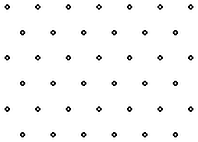
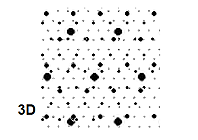
But by adding energy (movement/waves), the normal state can be disturbed.
Within this process, individual Nol can break away from the perfect
symmetry. The units are then called 'Nolites', they thus have physical existence and by
definition 'mass'. The opposite, i.e. a 'hole' in the vacuum fabric is
called a 'Nilite'.
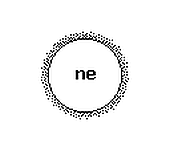
Larger particles (electrons, protons, etc.) are structured according to a
very strict 'vacuum geometry', i.e. their 3D pattern is precisely quantified
and follows certain geometric structures. However, individual Nolite and Nilite
entities are unquantified; they gather around charged particles in shell
formations (etherial matter) but without specific order. Image below: Eterial
matter; Nolite vacuum units, are seen gathering around the 'naked electron'
(ne).
The structure of the photon
The photons have a negative and a positive 'vacuum field' with an inherent
rotation (spin). Both fields shrink resp. grow in intervals. The vacuum
field of the photons is made up of mutual condensations of Nol and Nil where
both fields have equal mass and charge. Now, finally I present the
explanation why photons are pulled-out over time towards the red energy of the
spectrum:
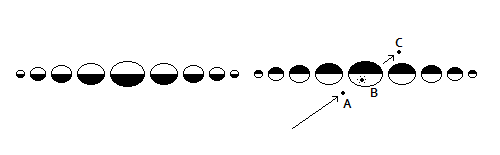
Photons 'thinned out'
As we mentioned, Nolites and Nilites are not quantified, they are
arbitrarily distributed in space. However, it can be established that
Nolites and Nilites are constantly being newly created and annihilated.
Thereby they maintain a constant and undefined 'amount per cubic range'
which is the same wherever in the universe one finds oneself. Let's call
this quantity 'NX'.
A light wave's interaction with NX means that both fields of photons (from
time to time) collide with single Nolites or Nilites. Regardless of which of
the vacuum units meets its antiparticle in the photon's mass, it will lead
to the photon's energy decreasing. If a Nolite 'extinguishes' a
Nilite in the photon's negative vacuum field (image A and B), the photon
will immediately compensate the loss of mass by emitting a Nolite in the corresponding vacuum
field (image C). Of course, the reverse can happen; a Nilite extinguishes a
Nolite whereby a Nilite is emitted. It should be noted that the 'C' Nolite in the image is not the same particle as 'A'
but a new Nolite emitted from the positive field of the light wave.
(Image size
proportions are not accurate, they are just illustrations)
In both cases, the general mass of the photon decreases and its wavelength
becomes longer. At small distances, the effect becomes insignificant, barely
noticeable. But with an 'old' photon, which has traveled several billion
light years, the result will soon be noticeable. The photons have been
thinned and redshifted!
Conclusion
The light
particles (photons) arriving from distant stars get 'diluted' while
traveling thousands and millions of light years until they reach our
location. This, in my opinion, is the 'engine' of the cosmic redshift. A
spectacular consequence of this phenomenon is that there is a final limit;
when we can no longer distinguish any photons, they've become weak and
actually undetectable.
This doesn't
mean that the objects of the universe have ceased to exist further away. No,
stars, galaxies, and clusters go on forever. It's just that we cannot detect
them any longer, but they are there all right! At what distance from Earth
does the light 'dim out' then? Good question, but this is really a problem
for cosmologers and mathematicians; have fun, people!
Disclaimer:
The information in this article is that of the
author and should not be confused with
conventional scientific views.
◄
Go back
|